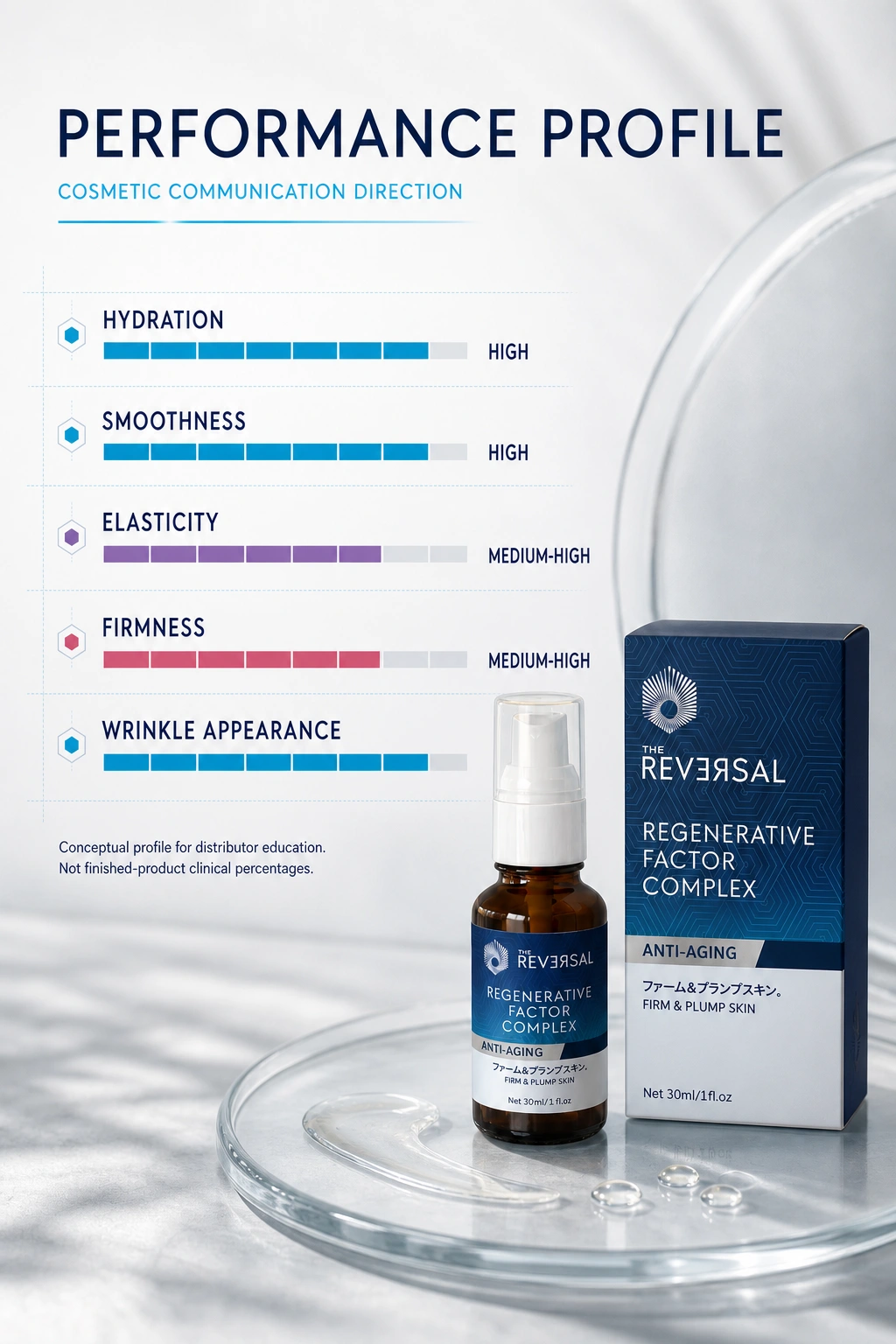
This block summarizes sales-facing visible outcomes in consumer-friendly language while staying within cosmetic communication boundaries.
RESULT PROFILEHydration · Smoothness · Firmness · Line appearance
Use as a visible-use result profile and as the endpoint set to measure when formally confirming finished-product performance.
01
うるおいのあるふっくらした肌うるおい・ふっくら感
乾燥やつっぱり感、肌のやわらかさ、光の反射などを観察します。
VISIBLE USER-RESULT LANGUAGE
02
なめらかな肌のキメキメ・なめらかさ
肌表面の質感や、乾燥による細かなラインの見え方を評価します。
VISIBLE USER-RESULT LANGUAGE
03
ハリと弾力のある肌印象ハリ・弾力
コラーゲン産生をうたうのではなく、見た目のハリや弾力を評価します。
VISIBLE USER-RESULT LANGUAGE
04
目立ちにくく見えるラインラインの見え方
表情じわや乾燥によるラインの見え方を観察します。
VISIBLE USER-RESULT LANGUAGE
Caption: This block functions as a sales-facing result profile and study-planning frame; before–after values, use duration and instruments can be added when finished-product reports are available.
DEVELOPER / PUBLISHED RESULT CONTEXT
Developer and Published Formula Result Context
This block uses raw-material developer information and published formula context to strengthen confidence in the smoother, plumper, firmer and softer-looking-line story.
Caption: This section lets the evidence support the product confidently through developer and published-formula context; once THE REVERSAL finished-product testing is available, product-specific figures can be added.
INGREDIENT NUMERIC EVIDENCE CONTEXT
Ingredient-Level Numbers That Support the Formula Story
These figures explain the EGF, IGF‑1 and Acmella rationale through mechanism and reference-formula context, making the page feel more like a clinical dossier without presenting them as finished-product results.
FIGURE NOTEMechanistic / reference-formula numbers, not direct product claims
Read these figures as supporting context: IGF‑1 strengthens the EGF cellular-readiness story, while Acmella has human reference-formula context for smoother, more hydrated-looking skin and softer-looking lines.
Figure 01 · Cellular comparisonEGF-binding readiness versus normal baseline
Normal baseline is set as 1.0× to show how IGF‑1 supports EGF-system readiness in a keratinocyte model.
1.0×Normal baseline
1.8×IGF‑1 average context
4×Peak cellular model
Figure note: This chart should be read as cellular-level IGF‑1 → EGFR-readiness context that supports the rationale of the Growth Factor Support System.
In keratinocyte data, IGF‑1-treated cells entered DNA-synthesis phase approximately three hours earlier than the EGF group, supporting a progression-support narrative.
Caption: This block makes the evidence more tangible using ingredient-level and reference-formula numbers, while creating a clear framework for adding Regenerative Factor Complex finished-product testing in the future.
Read from the desired visible result first, then connect back to the formula rationale—plumper, smoother, firmer-looking skin and softer-looking lines, supported by growth-factor biology and Acmella context.
Cosmetic interpretation
Use clear commercial cosmetic endpoints: smoother, firmer, more resilient, plumper and well-conditioned-looking skin, so readers understand the result immediately.
Outcome logic
Measure downstream outcomes through wrinkle grading, texture, firmness, elasticity proxies, hydration and comfort scores to read age-support care across multiple dimensions.
Interpretation boundary
Ingredient-level and reference-formula evidence adds weight to the Regenerative Factor Complex result story, making scientific sales communication more confident, credible and easy to read.
BLOCK 01 · ACTIVE SYSTEM
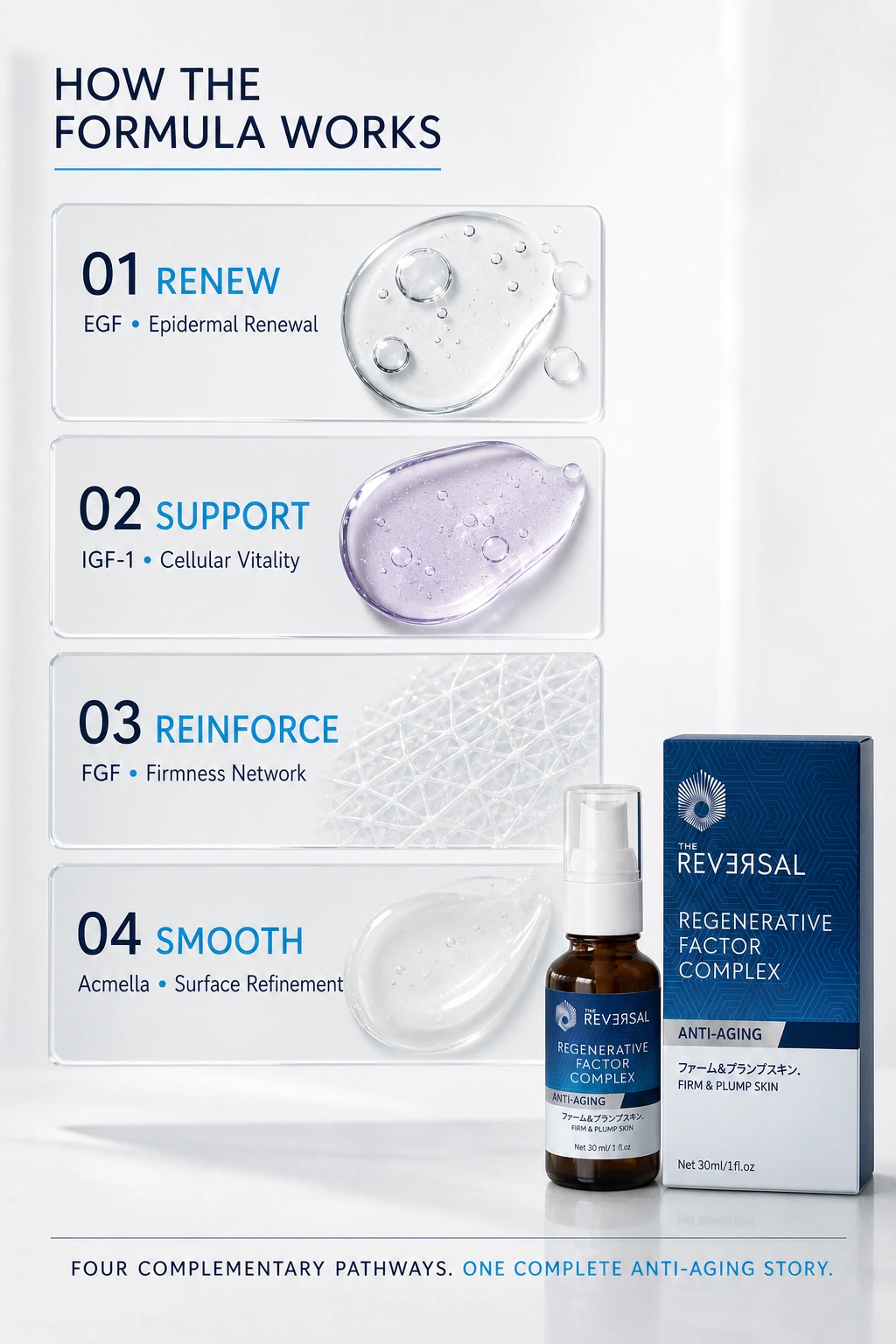
EGF · IGF-1 · FGF · Acmella
The four actives are positioned as a skin-conditioning and visible-line-care system. Each has a distinct scientific role and should be read within its own evidence frame.
Caption: This system is best communicated as a Growth Factor Support System supported by Acmella expression-line context for smoother, firmer, more resilient-looking skin and softer-looking lines.
BLOCK 02 · GROWTH FACTOR CONTEXT
Growth Factors in Topical Skin-Care Context
This block explains why growth factors strengthen the formula story around skin conditioning, smoothness, firmness and resilience beyond a basic moisturizing serum.
Research lensEGFR · keratinocyte · fibroblast context
Formula readingconditioning · smoothness · resilience
Result languageSmoother, firmer and more resilient-looking skin
Clinical reading note
When EGF, IGF-1 and FGF are organized as a Growth Factor Support System, the commercial strength is a better-conditioned skin story: smoother, plumper, firmer and more vital-looking skin.
01EGF
Epidermal-conditioning and smoother, fresher-looking skin context.
02IGF-1
Adds an intercellular-signalling perspective to the care system.
03FGF
Adds firmness / resilience context for skin that looks firmer and more elastic.
BLOCK 03 · MECHANISM PATHWAY
How the Formula Pathways Work Together
The formula is presented as a multi-pathway age-support system connecting surface texture, epidermal support, growth-factor signalling context and visible firmness, creating a complete story of smoothness, plumpness, firmness and softer-looking lines.
MECHANISM MAPSurface → Epidermal support → Signal continuity → Firmness context
This map explains the mechanism-reading sequence from surface texture to epidermal support, signal continuity and a firmer-looking skin impression.
EGF can be explained as an initiating epidermal-conditioning signal, IGF-1 as a support layer that helps the system continue, FGF as a firmness / resilience context, and Acmella as a smoother-looking expression-line complement. Together, they form an accessible yet cosmetic-scope story for lines, texture and resilience.
BLOCK 04 · ACMELLA CONTEXT
Acmella and Expression-Line Appearance
Acmella Oleracea Extract adds a consumer-understandable dimension to the Growth Factor Support System by supporting a smoother-looking skin and softer-looking expression-line story.
Acmella evidence fits wrinkle appearance, texture and smoothness endpoints, especially softer-looking expression lines and smoother-looking skin.
Visible lines
Appropriate for communicating a softer visible appearance of expression lines.
Texture
Supports a smoother, more refined visible texture when read with the Growth Factor Support System.
Premium wording
Use refined, precise wording such as expression-line care, smoother-looking skin and softer-looking lines.
Best wording
Smoother-looking skin and a softer appearance of expression lines.
BLOCK 05 · MEASUREMENT FRAMEWORK
Academic Measurement Framework for Regenerative Care
Regenerative Factor Complex should be evaluated through multiple visible endpoints—lines, smoothness, firmness, resilience and hydration—so the result story feels systematic and credible.
This table summarizes four endpoints suitable for cosmetic clinical reading of Regenerative care, focusing on visible and measurable outcomes.
01
しわ・表情じわ見た目の変化を評価
画像上のしわや表情じわを追跡する指標です。筋肉への作用を示すものではありません。
画像評価・しわスケール
02
肌のキメ・なめらかさなめらかな肌印象
肌表面の均一さや質感を確認し、成分や処方のケア方向を評価します。
画像解析・肌表面評価
03
ハリ・弾力ハリのある肌印象
弾力や firmness の変化を評価します。コラーゲン産生を直接示す指標ではありません。
Cutometer・専門家評価
04
水分・バリア状態うるおいと心地よさ
水分状態とバリア機能を確認し、肌のなめらかさや小じわの見え方と合わせて解釈します。
Corneometry・TEWL
Step 1
Separate wrinkle, smoothness, firmness and hydration endpoints first, so the system explanation does not exceed the evidence.
Step 2
Use standardized photography and expert grading alongside instruments such as Cutometer or Corneometer in real study design.
Step 3
Summarize results as visible age-support performance, not regenerative-medicine outcomes.
Step 4
If no finished-product clinical study exists, clearly use study-framework and ingredient-context language.
BLOCK 06 · FORMULA PERFORMANCE FACTORS
Quality Factors Behind Visible Results
This block positions Regenerative Factor Complex as a designed formula, not just a list of actives, by explaining the quality factors behind plumper, smoother, firmer, more resilient-looking skin and softer-looking lines.
Caption: This section strengthens credibility by showing that strong visible results depend on formula quality, stability, texture and real-use design working together.